24-Hour Arrival Guarantee
Get Fast Aircond Service, WhatsApp Us And Book In Just 5 Minutes

Professional Service
CIDB Certified Technicians

No Hidden Costs
Clear Transparent Pricing

Cheapest Aircond Service
Insanely Iow Prices For Aircond Installation And Servicing In Malaysia
Guaranteed Arrival Within 24 Hours!
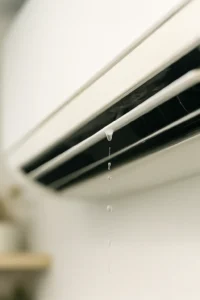
Aircond Leaking Water
Aircond Is Running But Not Cold
Noisy Compressor, Not Running
Not Cold? Get the Cheapest Aircond Installation & Aircond Service in Malaysia!
The most value-for-money aircond installation and servicing in Malaysia. 4-Hour Express Service.
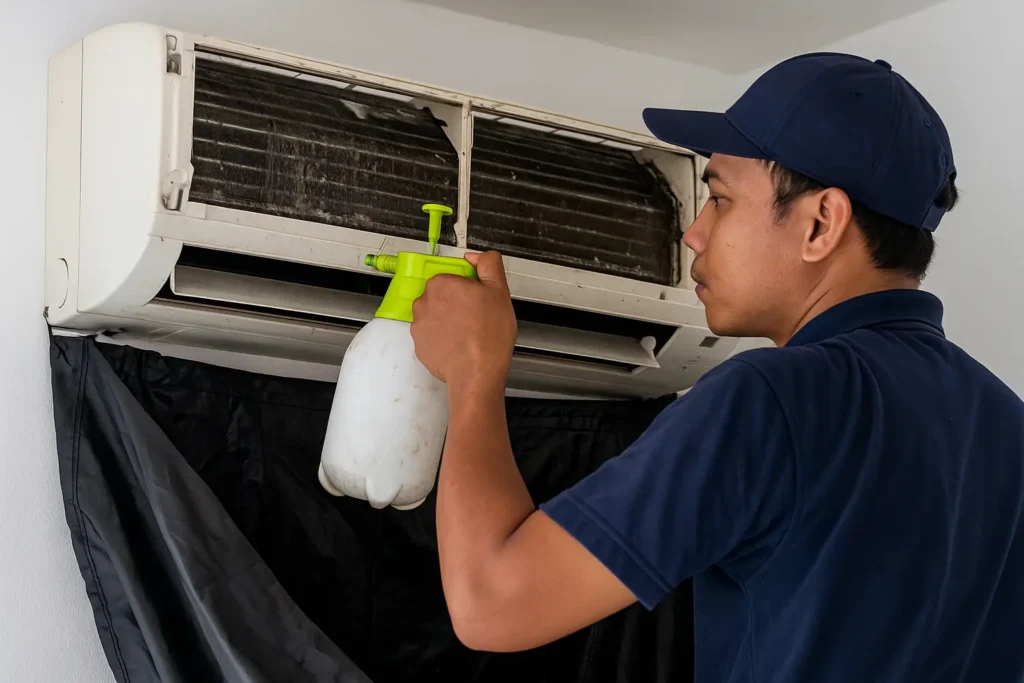
Aircond Service Malaysia
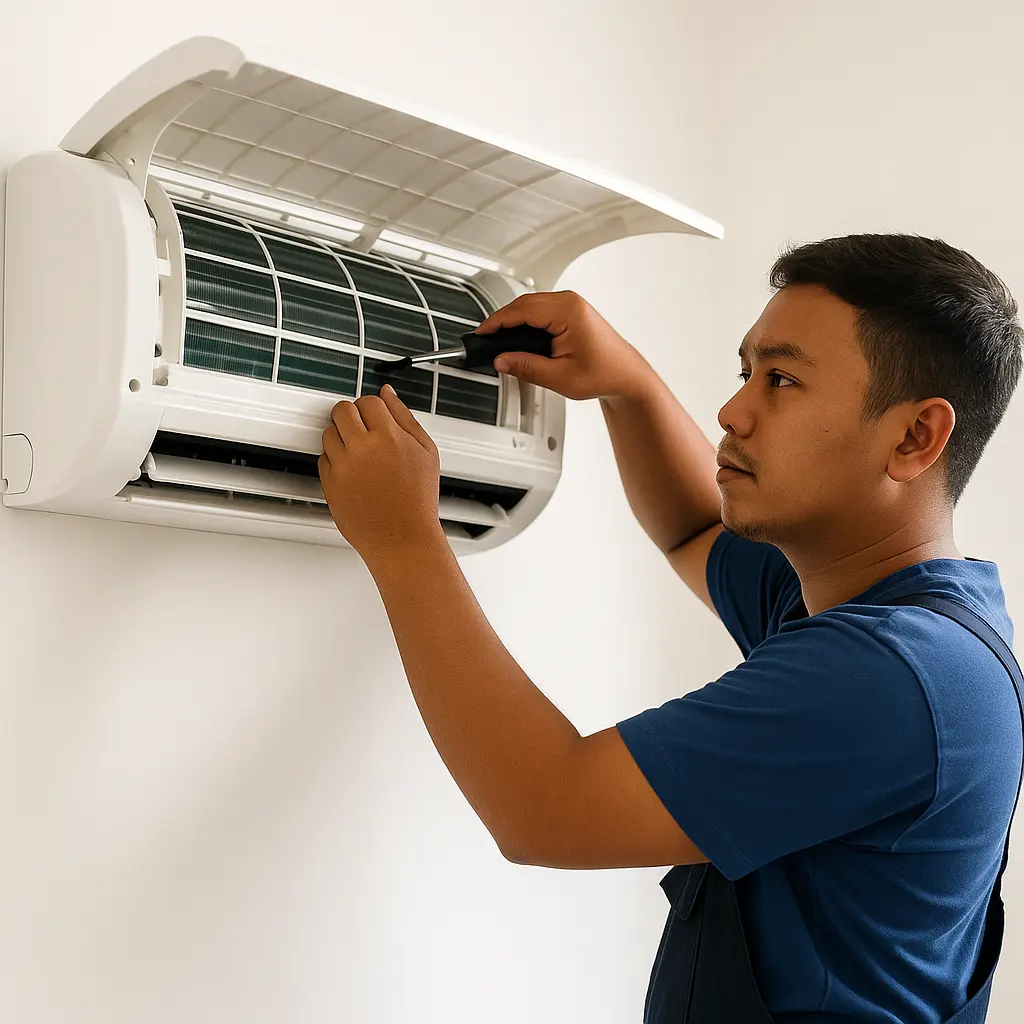
Aircond Installation Malaysia
Free 10 feet of copper pipe
Other Aircond Services Malaysia
4-Hour Express Aircond Installation & Service Malaysia. Same-day service available
Emergency Aircond Repair: What to Do When Your Aircond Stops Suddenly
Direct answer
When an aircond stops suddenly, treat it like triage: confirm the symptom (no power, not cold, tripping, leaking), record any blinking lights/error code, and avoid risky DIY electrical work. Many “emergency” cases are quick fixes—but only if the technician arrives with the right context and an access plan.
Quick answer
Sudden shutdowns usually fall into a few buckets: power/overload (trip), communication/control issues (blinking light, error code), drainage overflow (leak), or a mechanical protection stop (fan/compressor protection). The fastest path is not guessing—it’s narrowing which bucket you’re in.
In Malaysia, timing matters. Night use, condo access windows, and rain affecting outdoor unit work can turn a simple job into a reschedule if details aren’t shared early. A 2-minute note before dispatch often saves a second visit.
If you can safely observe: check whether the indoor unit has any lights, whether the remote responds, and whether the breaker tripped. Then stop there—anything beyond basic observation should be handled by a technician.
If you need cooling back fast
If it stopped suddenly and you need cooling back fast, WhatsApp or call with the symptom category (no power / not cold / trip / leak) plus any blinking pattern or error code. That helps us allocate the right slot and parts for emergency aircond repair.
Why local expertise matters
Emergency calls are about speed, but speed without proper diagnosis creates repeat issues — so it helps to avoid the wrong repair decision when symptoms overlap. A local technician who understands common Malaysia conditions—humidity, renovation dust, condo guardhouse/lift booking, and weather windows for ODU access—can plan the visit properly and avoid “arrive, can’t access, reschedule.”
Also, many “urgent” failures are not a single-component problem. A proper technician approach checks safety (trip causes), prevents mess (leak containment), and restores operation without forcing unnecessary replacements.
What emergency aircond repair is
Emergency aircond repair is an urgent troubleshooting and repair visit focused on restoring cooling and stabilizing the unit.
It’s for
- Families with night use and sudden failure
- Tenants needing fast restoration
- Home offices/shoplots where downtime affects work
- Situations involving trip, leak, or error codes
It’s not
It is not a “guess-and-swap parts” visit. The goal is safe restore plus reduced repeat breakdown risk.
What we typically do on an emergency visit
- Urgent diagnosis for no power / not cold / intermittent stop
- Trip investigation (breaker/overload) with safe isolation
- Leak isolation and drainage correction (when water overflow is involved)
- Error code/blinking light troubleshooting (control/communication)
- Targeted repair (as applicable) or recommendation for deeper follow-up
Step-by-step process
1) Triage before dispatch
Symptom category, timing, and any error code.
2) On-site quick checks
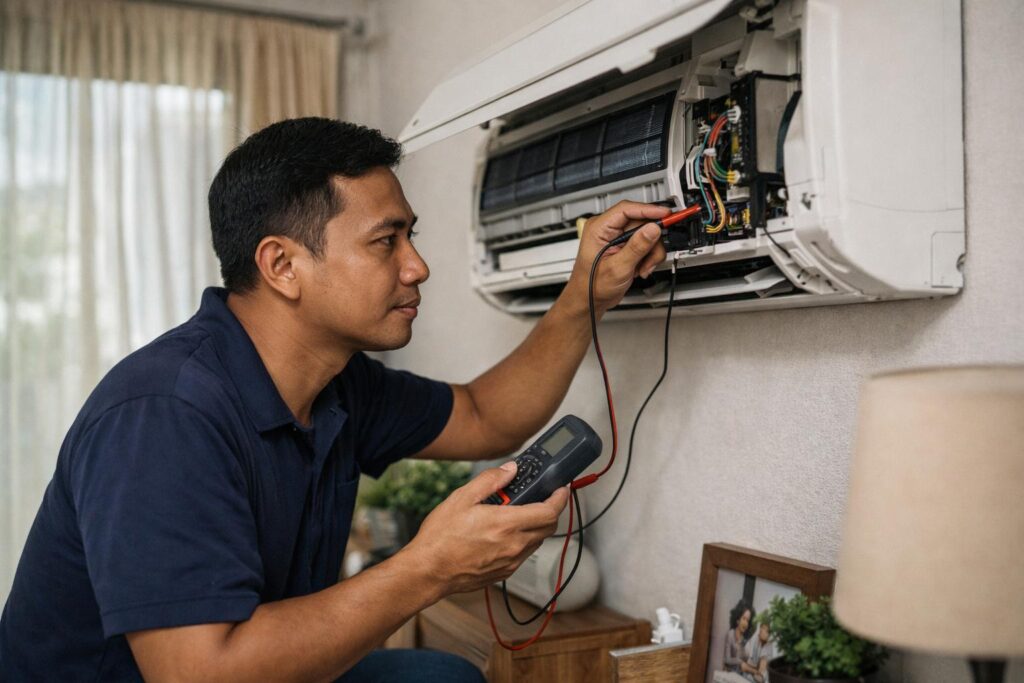
Power path, basic signals, obvious leak/overflow signs.
3) Isolate the failure bucket
Electrical protection vs control vs drainage vs mechanical protection.
4) Do the most direct safe fix first
Restore operation without forcing risky steps.
5) Run-stability test
Confirm it holds cooling and does not re-trip.
6) Explain what changed
What was done, why it stopped, and what to monitor over the next 24–48 hours.
What’s included and not included
Included
- Urgent troubleshooting to identify the main failure cause
- Immediate repair actions that are safe and appropriate on-site
- Leak containment approach (when water overflow is part of the problem)
- Run test to confirm stable operation after the fix
- Clear notes on what to monitor to avoid a repeat shutdown
Not included
- Guaranteed “same part replacement” without diagnosis
- Unsafe DIY electrical instructions
- Exact upfront pricing without seeing the unit condition/model (varies by situation)
Best-practice guidance by scenario
Condo/high-rise
Plan access windows (guardhouse preregistration, lift booking, loading bay). Emergency jobs fail when access fails.
Landed homes
Keep the outdoor unit area clear; sudden stops can be triggered by heat build-up or blocked airflow around the ODU.
Office/shoplot
After-hours repair may be possible, but depends on PIC access timing and building rules.
Homes with pets or renovation dust
Filters clog faster; sudden not-cold issues can show up earlier during heavy usage weeks.
Cost factors and what a fair quote includes
Cost varies by
- Symptom type (trip vs leak vs control issue)
- Unit type (inverter can be more complex)
- Access complexity (condo windows, parking, outdoor unit reach)
- Whether a targeted part is needed vs adjustment/cleaning correction
- Time window (after-hours may change scheduling logistics)
A fair quote usually includes
- A clear scope (what will be checked and what “restore operation” covers)
- The likely failure bucket based on triage info
- What is included in the emergency visit vs what would be follow-up work
- Run-test confirmation after repair action
- Notes on risk controls (prevent repeat trip, prevent leak mess)
Common problems and what usually helps
Aircond no power
Often tied to power-path issues or control faults; the key is confirming if it’s a supply issue or an internal protection stop.
Aircond not cold suddenly
Could be ODU not running, fan/compressor protection, or control/communication issues. Quick isolation prevents wasted “gas-only” assumptions.
Aircond leaking water suddenly
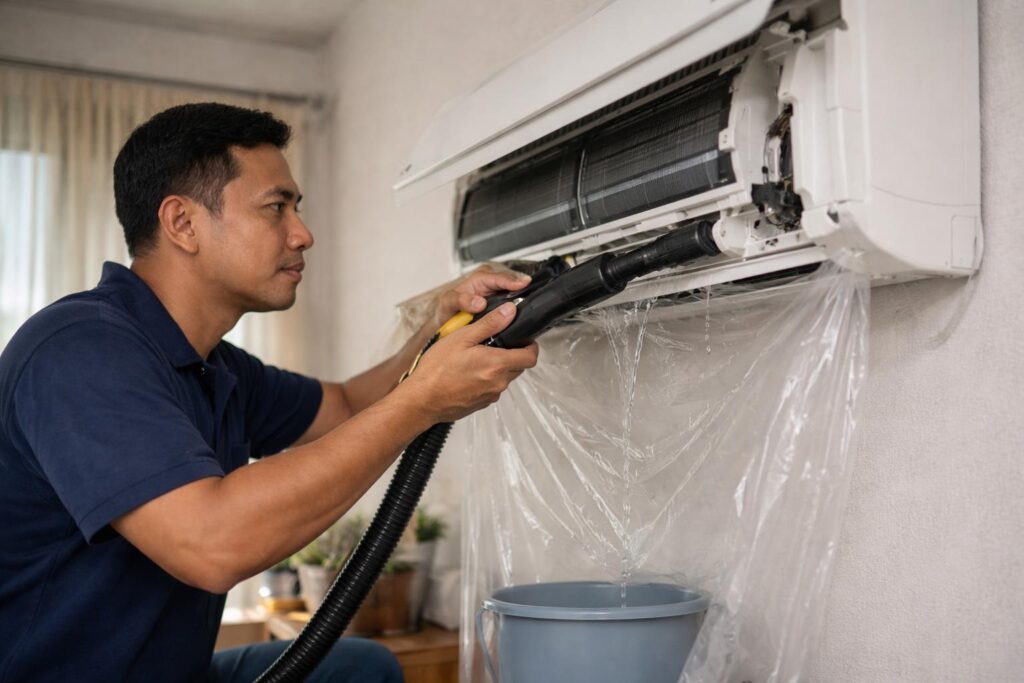
Commonly drainage overflow or blockage; urgent containment and drainage correction prevents ceiling/wall damage.
Aircond tripping breaker
Treat as safety-first. It can be overload, short, or a failing component. A proper check avoids repeated trips.
Blinking light or error code
Record it; many inverter systems point directly to the subsystem affected.
Decision Tree: What to do if…
- If the breaker/MCB tripped when you turned it on, stop restarting repeatedly and call for emergency aircond repair (repeat trips can worsen damage).
- If you see water dripping fast or ceiling stains, switch off, protect the area, and request urgent leak isolation.
- If there’s blinking light or an error code, record the pattern/code and share it before dispatch.
- If it runs for 2–5 minutes then stops, note the exact timing and whether the outdoor unit starts (helps identify protection vs control).
- If the remote doesn’t respond but indoor lights are on, treat it as a control/signal issue and share the details; don’t open electrical covers.
Verification Checklist
How to verify the emergency stop was handled properly
- They asked for symptom category and when it happened (not just “not cold”).
- They checked for trip causes and didn’t keep forcing restarts.
- They recorded/confirmed any blinking pattern or error code.
- They explained what subsystem was isolated (power, control, drainage, mechanical protection).
- They performed a run test long enough to confirm stability.
- They told you what signs to watch for in the next 24–48 hours (repeat trip, leak return, intermittent stop).
Mistakes to avoid
- Restarting the aircond repeatedly after a trip (can escalate the fault).
- Assuming “top up gas” is the emergency fix without checking whether the ODU is even running.
- Not recording error codes/blinking patterns (wastes the first visit).
- Booking a slot without considering condo access windows (guardhouse/lift/bay).
- Ignoring early leak signs (a small drip can become a big mess during night use).
Pre and post checklist
Before the technician arrives
- Note the exact symptom: no power / not cold / trip / leak / blinking/error code
- Record when it happened (time and what you were doing)
- If condo: confirm guardhouse/lift/parking rules and any booking windows
- Clear a small working area near the indoor unit; keep pets away
After the repair
- Confirm cooling holds steady for a reasonable period
- Ask what caused the sudden stop (bucket and key evidence)
- Ask what to monitor over the next 1–2 days (trip/leak/intermittent stop)
- Schedule follow-up servicing only if it’s relevant to the identified cause
FAQs
Emergency repair focuses on sudden failure and restoring safe operation quickly (no power, not cold, trip, leak, error code). Normal servicing is preventive cleaning/maintenance when the unit still runs but performance is declining.
Often yes, but it depends on technician availability, building access rules, and whether outdoor unit work is safe in the current conditions (especially in rain).
Common buckets include overload, short, a failing electrical component, or insulation issues. Treat it as safety-first and avoid repeated restarts.
Record the exact blinking pattern, any error code displayed, and whether the outdoor unit starts. Also note the time it happens (immediately, after a few minutes, or intermittently).
Not always. It can also be the outdoor unit not running, fan/compressor protection stopping operation, or control/communication issues.
Protection trips, sensor/control issues, unstable power path, or mechanical protection related to airflow/heat load. Timing (2–5 minutes) is useful for narrowing it down.
If water is dripping fast, staining the ceiling/wall, or near electrical points, treat it as urgent. If it’s a slow drip and contained, it may wait—but monitor closely.
If access isn’t arranged (registration, parking, lift booking), the technician may arrive but can’t reach the unit or outdoor area—causing delays or rescheduling.
Confirm the symptom category, check for any lights/error code, see if the breaker tripped, and switch off if there’s leak or repeated tripping. Then share the observations when you call.
It varies by the failure bucket and access. Quick fixes can be short, while trip investigations or intermittent issues may take longer due to testing and stability checks.
Yes. Inverter systems can stop if communication/control signals between indoor (FCU) and outdoor (ODU) are interrupted or detected as abnormal.
Follow the technician’s monitoring notes for 24–48 hours, avoid forcing repeated restarts if it trips, and schedule targeted follow-up only if it matches the identified cause (not “just in case”).